

Stream Hiking Fishing: Why Your Next Step Should Be a Telescopic Leap
The sound is what gets you first. Not the birds, but the relentless, roaring rush of whitewater funneling through a granite chute. You’re three miles up a trail no car will ever see, muscles burning, and there it is: a perfect, turquoise pool carved behind a house-sized boulder. This is the moment you’ve hiked for. You scramble down, heart pounding, and assemble your trusty 7-foot, two-piece rod. You make a careful backcast—and instantly hear the sickening crunch-tick-tickof your rod tip demolishing itself against the unyielding cliff face behind you. The dream of a wild trout for dinner evaporates with the sound of breaking graphite. I’ve been there, holding the two pieces, feeling like the world’s most clumsy explorer. It was that exact, costly mistake that forced me to rethink everything. The solution wasn’t trying harder with the wrong tool; it was the telescopic fishing rod. In the world of stream hiking, especially in fast, confined water, it’s not just a convenience—it’s a revolution in accessibility. Let’s dive into why. 🌊🎣
The Physics of Confinement: Why Fast Water Demands a Different Tool
Fishing a mountain stream isn’t like lake casting. It’s a three-dimensional puzzle of hydraulics, obstacles, and limited space. The fast water you’re targeting is oxygen-rich and holds aggressive fish, but it’s often bordered by dense brush, overhanging branches, and sheer rock walls. A study on stream fish ecology in Transactions of the American Fisheries Societynotes that trout in such environments are “lie-oriented,” holding in specific seams and eddies. Presenting a fly or lure to them requires pinpoint accuracy, not long, sweeping casts.
This is the telescopic rod’s genius. Its collapsible design allows for a crucial tactic: the bow-and-arrow cast or the ultra-short, vertical flip. When you’re wedged between a boulder and a spruce tree, you can’t perform a standard overhead cast. A fully extended 7-foot rod is a liability. A telescopic rod, collapsed to 4 feet for the approach, can be extended to just the right length—often 5 to 6 feet—to dap a fly into a pocket six feet away without ever moving the rod butt behind you. It turns cramped, “unfishable” water into your most productive spot.
Beyond Convenience: The Modern Telescopic is a Performance Tool
The old stigma is dead. The “wobbly, insensitive pool cue” of the past has been replaced by engineering that rivals traditional rods. The key is in the materials and construction.
-
The Blank: Modern performance telescopic rods use high-density, high-modulus carbon fiber. The sections are engineered with precise, tapered overlaps that, when fully extended and locked, create a continuous, sensitive blank. The action is typically fast to extra-fast—perfect for the quick, snappy hook sets needed in current.
-
The Guides: This is critical. Cheap telescopics have plastic rings that bind line. Quality models feature miniaturized, stainless-steel framed guides with ceramic or aluminum oxide inserts, spaced to create a smooth curve that handles modern braided fishing line and sensitive fluorocarbon leader without friction or choking. The line flows freely, which is essential for detecting subtle takes in turbulent water.
-
The Locking Mechanism: The old screw-lock systems that loosened mid-cast are gone. Modern systems use a twist-and-lock or push-button mechanism that creates a solid, reliable connection. You should be able to fight a fish with confidence, not a prayer.
Building Your System: The “Trail-to-Stream” Kit
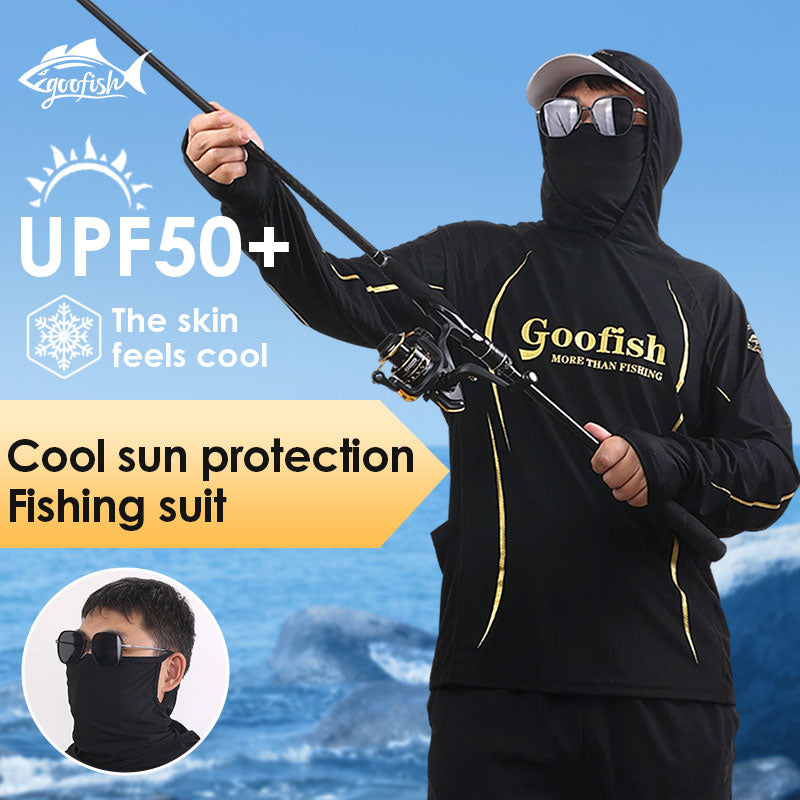
A rod is just the start. For stream hiking, every component must be chosen for the mission. This is where the keywords from your image—backpacking fishing rod and reel, goofish travel fishing rod, compact fishing rod for hiking—transform from search terms into a functional arsenal.
-
The Rod: The Heart of the System
When you evaluate a rod like the goofish travel fishing rod, you’re not just looking for “small.” You’re evaluating its extended performance. Key questions: What is its action and power when fully extended? A quality compact fishing rod for hiking should offer a medium-light to medium power and a fast action, perfect for throwing small spinners, spoons, and lightweight flies. Its collapsed length (often 16-24 inches) means it can ride vertically in a backpack’s water bottle pocket, completely protected and out of the way.
-
The Reel: The Balanced Partner
This is about synergy. A backpacking fishing rod and reel combo works because they’re weight-matched. A bulky, heavy reel on an ultralight telescopic rod kills its feel. A 1000 or 2000-size spinning reel is ideal. It should be lightweight, have a decent drag (smoothness is more important than max strength for stream trout), and, crucially, be spooled with the right line.
-
The Line: Your Connection to the Current
-
Mainline: Use 5-10 lb braided fishing line. Its near-zero stretch is a superpower in moving water. You’ll feel every rock tick and every nip directly. Its thin diameter also reduces drag in the current.
-
Leader: Always use a fluorocarbon leader (2-4 lb for clear, small streams, 4-8 lb for bigger water). It’s nearly invisible and more abrasion-resistant than mono against rocks. The Double Uni knot is perfect for connecting braid to fluoro in the field.
-
-
The Terminal Tackle: Think Small and Simple
A tiny, flat tackle box holds your stream universe: 1/16 oz inline spinners, small casting spoons, a few weighted nymphs, and a pack of size 10-14 hooks for bait. In fast water, flash and vibration are key.
The Technique: Reading Water and Executing with Precision
Your tool is ready. Now, let’s use it.
-
Step 1: The Stealthy Approach. Keep your rod collapsed. Move slowly, using the stream’s sound to mask your movement. Wear muted colors. Fish upstream, as trout face into the current. Your collapsed rod is less likely to spook fish with sudden movement.
-
Step 2: The Strategic Extension. Size up the lie. A wide pool? Extend the rod fully for a longer, more controlled drift. A tiny pocket under a root wad? Extend only the first few sections for a short, precise dap.
-
Step 3: The “High-Stick” Drift. In fast, broken water, use a short line. Hold your rod tip high, keeping most of your line off the turbulent surface. Follow your fly or lure with the rod tip as it drifts downstream. This “high-sticking” gives you a direct, drag-free drift and instant strike detection. The sensitive tip of a good telescopic is perfect for this.
-
Step 4: The Hook Set and Fight. In current, a trout often takes and rejects in a split second. The moment you see your line jump or feel any resistance, a quick, upward flick of the wrist is all that’s needed. The rod’s fast action will drive the hook. Use the rod’s bend to absorb headshakes, and let the current help you guide the fish to calm water.
The Real Reward: Freedom Found in Compact Form
The ultimate test of my goofish travel fishing rod came on a trailless scramble to an alpine basin. My pack was full of camping gear. The 18-inch rod tube was strapped to the side. When I finally reached the series of cascading pools, I was exhausted. In 30 seconds, I had a rod in hand. I couldn’t make 50-foot casts, but I didn’t need to. I made 10-foot presentations to water that had likely never seen an artificial lure. The result was a series of stunning, wild cutthroat trout, each a jewel in that high mountain setting. I caught them not in spite of my gear, but becauseof it.
Stream hiking fishing with a telescopic rod redefines the sport. It’s not about power fishing; it’s about opportunistic precision. It’s about having a capable tool that doesn’t just get you to the water, but gets you intothe water, into those tight, wild, and productive places that longer rods simply can’t reach. Ditch the bulk, embrace the compact, and go find the fish that others walk right past. 🏔️



0 comments